
Do you find yourself dreaming of starting your own business – perhaps one day opening a chicken-based fast-food franchise? If so, then you are not alone. Here’s why chicken franchise opportunities may help you achieve many of your business and financial goals.
Chicken has become a staple on almost every menu, whether through its crunchy fried form, or as part of some very hot wings or grills. The trend is clear: chicken is extremely popular. With chicken being the number one protein eaten in the United States, per capita availability is expected to hit 102.8 pounds.
Opening a chicken restaurant is an easy way into franchising and provides long-term growth. The chicken restaurant business provides a great entry point for both veterans in the industry and those looking to take their first step into franchising with real growth opportunities.
In this blog, we’ll take a closer look at what makes the chicken franchise industry so appealing, talk about proven business models, and share how you can get your hands on a slice of this profitable pie. If you’ve been wondering why this niche keeps outperforming the competition, keep reading.
Why Chicken Franchise Ownership Could Be The Next Big Move
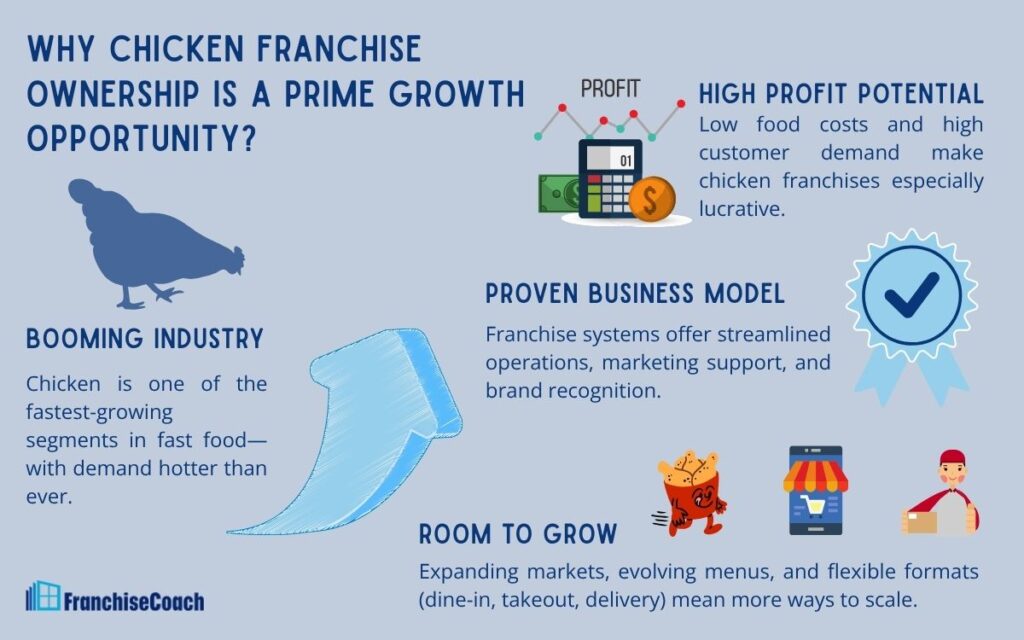
The chicken franchise industry is an extremely attractive business option for investors who are looking to increase their presence within the fast-food franchise market. Huge consumer demand, combined with a proven strategy for generating profits as a franchise owner, makes this market a lot going for it.
It’s not just about finger-licking’ good tenders and mouthwatering sandwiches. It’s a cracking franchise opportunity with long-term continued growth on the horizon.
While taste is certainly a major factor when considering buying food, there is also a strong case to be made for why investing in a chicken-based franchise can be one of the most solid investments you’ll make, with many years of future growth potential available.
1. The Chicken Franchise Industry Is on Fire

Let’s talk about some of those numbers. The U.S. chicken franchise industry reached $63.7 billion in 2026. Not only is this impressive, but it also shows that chicken franchises dominate the market.
Did you know? Chicken-based restaurant sales grew by almost 12% in 2025, while the burger chain sales were up only 1.5%.
When you look at some older (but still pretty successful) chicken restaurants like Golden Chick or KFC, what you find is that most have been able to create a very loyal clientele through focusing on how well they can do business operations.
If a restaurant can provide high-quality food, quick service and is willing to test new menu items, then they will likely continue to grow and succeed with little problem.
2. Strong Business Model with Built-In Franchise Support

Owning a quick service restaurant (QSR), is more than owning a restaurant – it’s stepping into an operating system. Business models, operational processes, brand identity, and daily routines typically exist as part of an existing QSR setup.
Newly acquired franchisees can expect full-scale training by their franchisor, as well as ongoing support for new or developing locations.
This support may include:
- Marketing strategies and nationwide advertising from the franchisor.
- Support with site location to find high-traffic locations.
- Drive-thru technology and online order capabilities are provided through technology platforms developed by the franchisor.
- Development of research and trend analysis regarding consumers’ preferences.
- Research and development focused on consumer trends.
A positive working relationship between the franchisor and franchisee will be essential to the continued success of the operation.
3. Initial Investment and Best Franchise Profit Potential

The initial investment for a chicken franchise typically ranges from $200,000 to $2 million. This wide range depends on the brand, location, and specific startup costs.
Specifically, your franchise investment covers the initial franchise fee, which is the cost to join the established brand, as well as the equipment needed for high-volume cooking, franchise fees for ongoing support, and the real estate costs associated with a prime restaurant location.
Your total investment will be comprised of the initial franchise fee that allows you to use an existing company name, equipment necessary for large volume cooking and preparing food products, franchisee fees for continued assistance, and leasehold improvements to a commercial location to operate a restaurant.
The profit margins are substantial. Quick Service Restaurants (QSRs) have average profit margins ranging from 5% to 15%, while leading operators generally earn higher margins, such as 15-30%.
Fried Chicken restaurants have even greater profit margins than average QSR’s due to fried chicken being able to retain both heat and texture when delivered.
4. Room to Grow

There is a tremendous opportunity for expansion. As many current franchise owners grow into multiple-unit ownership, they will be able to utilize economies of scale to dominate their local markets.
A solid national or regional brand will also support growing from a single location into multiple locations as an economically viable and very profitable future direction.
If you’re still comparing opportunities, check out “8 Franchise Business Ideas Worth to Start” to explore other profitable franchise paths before deciding.
Steps to Start a Chicken Franchise
Beginning a chicken franchise is not something you should enter into lightly. While chicken is popular and can sell quickly, most successful franchises were founded on finding the correct concept for the appropriate geographic area and developing a strategy before opening.
Step 1: Look at Your Options (and Your Market)
It is essential to understand if the concept you have fallen in love with will be viable before investing. Below are several successful chicken franchise options:
Fried Chicken Franchise
Fried chicken continues to remain a popular choice among American consumers. According to the NPD group, approximately 50 percent of U.S. adults enjoy fried chicken. Additionally, 49 percent of Americans consume fried chicken weekly.
Chicken Wing Franchise
Socializing while eating wings has become a very common practice. Examples of restaurants that offer a fun and dynamic atmosphere while providing high-demand flavors include Buffalo Wild Wings.
Grilled Chicken
The grilled chicken franchises cater to a growing group of health-conscious consumers. Grilled chicken offers low-fat protein sources as well as customizable meal options.
Fast Food Chicken Tenders or Fingers
Tenders or chicken fingers are quick and simple. This simplicity makes it easy to create, serve and allows customers to easily agree to purchase.
Chicken Sandwich Franchises
This has been extremely popular in recent years during what was called a “chicken sandwich war.” Chick-fil-A has done well with these because of its reputation and excellent customer service.
Step 2: Review the FDD or Franchise Disclosure Document and Initial Franchise Fee

Obtain an in-depth knowledge of your franchise agreement and the initial franchise fee. The Franchise Disclosure Document (FDD) provides you with a wealth of information regarding your potential franchise investment. Some of this includes:
- The training program and support provided to new franchisees.
- Data related to existing franchisees' revenue levels.
- Any contact information available that may be used to communicate with other existing franchisees.
- Specific terms within the contract/agreement.
3. Site Selection

When selecting a good location for your chicken franchise concept, do not rely solely on the “vibes” of an area. The success in fast food comes down to “location, location, location” and requires a serious evaluation of the area and how many people typically dine out.
The franchisor will most likely assist you in choosing a site by providing site selection assistance, which can be used to select a site that has great market potential and proximity to schools, office buildings, or shopping areas.
Having a site that accommodates a drive-thru and makes it easy for customers to obtain their fried chicken orders via pickup will create the greatest amount of financial returns from your investment as this type of diverse revenue source is key to the growth of the restaurant industry.
If possible, use statistics from your franchisor or local data to validate your decision.
Fried Chicken also holds very well after being transported due to its ability to retain its crispness and hot temperature, allowing it to be perfectly suited for delivery and other forms of off-premises dining.
4. Build Your Team

Your employees can either make or break the customer experience at your chicken restaurant. The first thing that most consumers notice when they visit a restaurant is the staff. Their reliability in performing tasks as directed (e.g., serving food, answering phones) affects the success of your business.
When hiring, seek out individuals who value quality, punctuality, and treating others well. A friendly, dependable staff generally generates better results than someone with a good resume.
The programs provided by franchisors are designed to assist in ensuring the same level of quality every week in items such as French fries, sandwiches, and chicken tenders. Most franchisors have extensive training programs for new franchise owners, which include ongoing support from the franchisor.
Using a simple matrix of key skills (speed, accuracy, cleanliness), you should be able to get your employees working at the standard set by the brand and attracting repeat customers.
5. Planning a Grand Opening That Leaves a Lasting Impression
Your grand opening event is a moment when you can show off what your business has to offer and how well you are going to do business in the future. It will be a moment of truth and an opportunity to establish the quality of service that all new and returning customers expect from you.
You don’t need to develop a whole new game plan – work closely with your franchise company to leverage their established and successful launch strategies and templates.
Build anticipation before you even open up to create an immediate impact. You want people buzzing about your franchise opportunity before the doors even swing open. A few ideas that work well include:
- Offering limited-time deals on your top flavor profiles to get diners in the door.
- Countdowns and teasers on social media will generate engagement among Millennials and Gen Z.
- Partnering with local schools or sports teams to build brand recognition.
- Highlighting your diverse menu offerings, including traditional fried chicken as well as healthier grilled chicken options.
FAQs
Why is owning a chicken franchise considered one of the best profitable franchises?
Because there are a lot of people who buy food from the chicken franchise-type restaurants. This is due to the fact that these types of restaurants have a wide variety of chicken products on their menus, which keeps the consumers coming back.
Because chicken is the second most consumed protein in the world and as such has a steady supply and a constant stream of customers at your restaurant, which generates revenue for you continuously and allows you to grow over time.
What makes chicken franchises appealing to investors and entrepreneurs?
The reason that so many chicken franchise owners are successful is that they can use the franchisor’s model, which includes a proven business model, training programs, marketing plans and other tools that help them succeed.
What is the typical initial investment for a chicken franchise?
Typical investments range from $200,000 to over $2 million, based upon such items as brand name, your chosen location and build-out costs. Your franchise fee, equipment needs, training requirements, and all required supplies (opening inventory) will need to be considered in determining what you can afford.
How do I choose the best location for my chicken franchise?
Consider demographics within the area where you plan to locate, traffic flow, median household incomes and eating habits. A high-traffic area near office buildings, schools, shopping centers or public transportation hub(s) is preferred.
Is a chicken franchise a good franchise to start for first-time business owners?
Yes. With structured support, proven operations, and comprehensive training, chicken franchises are ideal for new entrepreneurs looking for a guided entry into the food industry.
Final Thoughts
Fast food chicken franchises remain so popular because their customers continue to buy from them.
The menu is appealing to many different types of customers. Once someone finds a chicken restaurant that they like, it seems most likely they will go there repeatedly. And when you have an existing name-brand, you do not have to create all of your systems from scratch; you can follow established systems that have been proven.
You will increase your chances of creating a steady customer base by taking the time to develop your strategy, assembling the right staff, and utilizing the ongoing support provided by your franchisor.
If you are ready to make your decision about acquiring a franchise, FranchiseCoach Adam Goldman may be a valuable source of information. They can help potential franchisees with the costs, territory details, and what to expect before signing a franchise agreement.
Take the first step towards developing a thriving business in one of the fastest-growing markets today!