
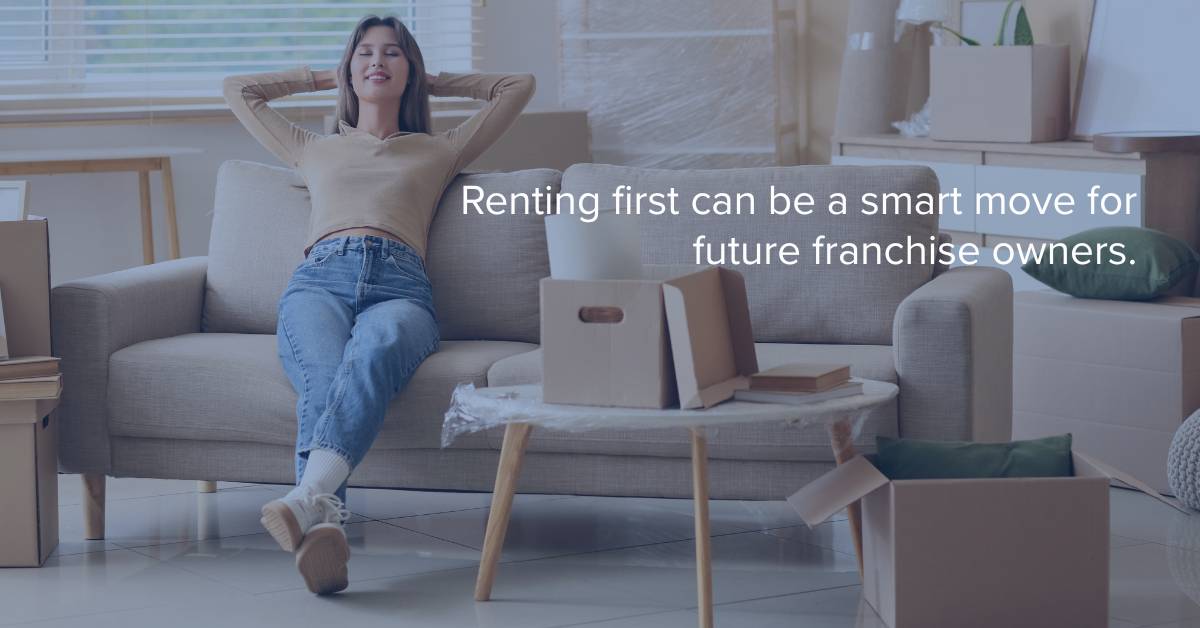
Renting isn’t settling. For aspiring franchise owners, it might be the smartest financial move you make before signing your franchise agreement.
There’s a deeply rooted cultural narrative that says homeownership is the ultimate marker of financial success. Buy the house, build equity, plant your roots. It’s the conventional playbook, and for many people, it works beautifully. But if you’re someone who’s looking to start a business, or if you have franchise ownership on your radar, the conventional playbook might not be your playbook. At least, not right now.
What if the most strategic thing you could do for your future franchise is to keep renting?
It sounds counterintuitive, but when you look at the financial mechanics of launching a franchise, staying a renter starts to look less like a compromise and more like a calculated power move.
The Capital Conversation No One Is Having
Let’s talk about the elephant in the room: money. Franchise investments vary widely, but even on the more accessible end of the spectrum, you’re likely looking at an initial investment somewhere between $50,000 and $250,000 or more, depending on the brand and the industry. That includes your franchise fee, buildout costs, equipment, working capital, and a dozen other line items that show up in Item 7 of the Franchise Disclosure Document.
Now consider the financial commitment of buying a home. A down payment alone — typically 10 to 20 percent of the purchase price — can easily consume $30,000 to $80,000 or more, depending on your market. Then there are closing costs, property taxes, homeowners insurance, maintenance, and the inevitable surprise expenses that come with owning a property.
When you stack those two financial commitments side by side, the math gets tight fast. And for aspiring franchise owners, tying up a massive chunk of liquid capital in a down payment can delay — or even derail — the business timeline entirely.
Renting an apartment, on the other hand, keeps that capital fluid. It stays in your account, ready to be deployed toward the investment that’s actually going to generate income and build long-term wealth on your terms.
Liquidity Is Your Superpower
In the franchise world, liquidity isn’t just helpful; it’s often a requirement. Most franchisors want to see that candidates have a certain amount of liquid capital available before they’ll approve an application. This isn’t an arbitrary gatekeeping exercise. It’s because franchisors know that undercapitalized owners are at a significantly higher risk of failure.
When you’re renting, your financial profile tends to look very different from someone who just closed on a house. Your debt-to-income ratio is typically more favorable. Your savings are more accessible. Your monthly obligations are more predictable. All of this positions you as a stronger franchise candidate and, more importantly, a more resilient business owner once you’re operational.
Those first 12 to 18 months of franchise ownership can be lean. Having a financial cushion like the kind that comes from not having a mortgage, property repairs, and a lawn care budget eating into your reserves can make the difference between weathering the startup phase with confidence and scrambling to keep the lights on.
Flexibility Is a Feature, Not a Bug
There’s another dimension to this strategy that goes beyond dollars and cents: mobility. This shift in housing preferences is visible is the Gen Z and Millennial generations which move away from the traditional perspective and choose the flexibility and convenience of lifestyle renting.
When you’re evaluating franchise opportunities, geography matters. The best territory for your chosen brand might not be in your current zip code. It might be two towns over. It might be in a completely different state. Renting gives you the freedom to relocate quickly and strategically, positioning yourself wherever the opportunity is strongest.
Homeownership, by contrast, anchors you. Selling a home takes time, costs money, and introduces uncertainty into a process where you want to be moving forward with clarity and speed. If the ideal franchise territory opens up six months from now in a market you don’t currently live in, being a renter means you can act on that opportunity without the burden of unloading a property first.
This kind of operational flexibility is a genuine competitive advantage in the early stages of franchise ownership. It lets you make decisions based on business logic rather than real estate logistics.
Reframing the Narrative

Here’s where a mindset shift makes all the difference. Renting has long been framed as something you do before you can afford to buy. It’s treated as a temporary state, a stepping stone, almost an apology. But that framing doesn’t serve aspiring franchise owners well.
Instead, think of renting as a strategic allocation of resources. Every dollar that doesn’t go into a mortgage payment, a roof repair, or a property tax bill is a dollar that can go into building your business. You’re not avoiding homeownership — you’re choosing to prioritize a different kind of investment. One that has the potential to generate revenue, create jobs, and build equity in a way that a residential property simply can’t match.
Franchise ownership is, at its core, entrepreneurship with a proven system. You’re buying into a model that’s been tested, refined, and supported by a larger organization. The returns — both financial and personal — can be extraordinary. But only if you set yourself up for success from the start.
The Long Game
None of this means you should never buy a home. For many franchise owners, homeownership becomes a natural next step once the business is established and generating consistent cash flow. At that point, buying a home isn’t a financial stretch, but rather a reward funded by the business you built because you were smart about your capital early on.
That’s the real trade-off worth understanding. It’s not renting versus owning. It’s renting now so you can own more later — a thriving franchise, and eventually, that house too.
Think of it as sequencing. Successful franchise owners are strategic thinkers. They understand timing, market conditions, and resource allocation. Applying that same strategic thinking to your personal finances before you even sign a franchise agreement is a signal that you’re already thinking like a business owner.
Making Your Move
If you’re sitting on savings and debating whether to funnel them into a down payment or a franchise investment, take the time to run both scenarios honestly. Consider your five-year financial trajectory in each case. Talk to a financial advisor who understands both real estate and business ownership. Speak with existing franchise owners about how they managed their capital in the early days.
And most importantly, give yourself permission to challenge the default narrative. Renting isn’t a failure to launch. When it’s done intentionally, with a clear plan and a bigger goal in sight, it’s one of the most disciplined financial strategies an aspiring franchise owner can adopt.
The franchise you’ve been dreaming about doesn’t care whether you have a mortgage. It cares whether you have the capital, the focus, and the readiness to build something great.
Keep renting. Keep saving. Keep planning. Your franchise — and eventually, your dream home — will thank you for it.